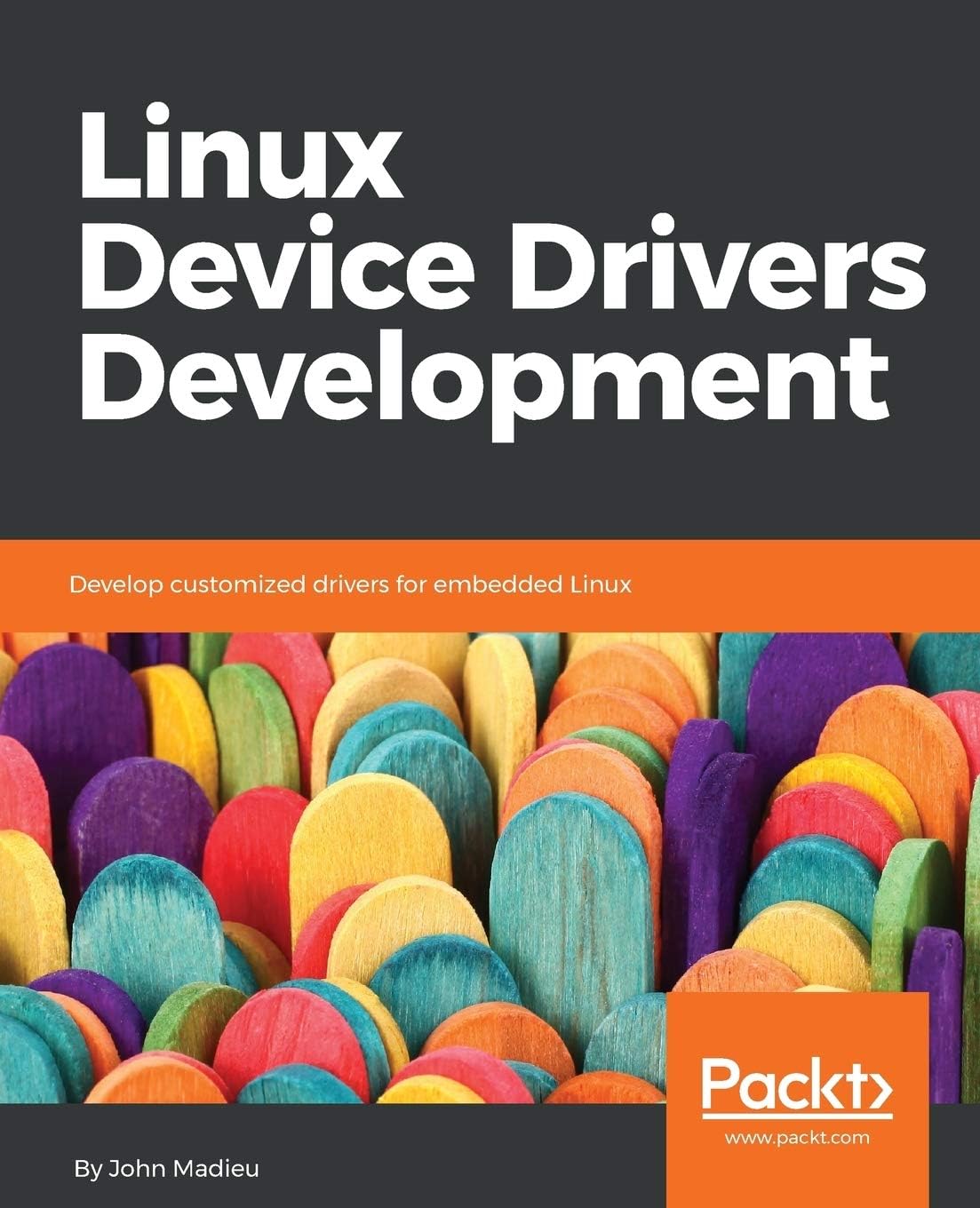
Linux Device Drivers Development: Develop customized drivers for embedded Linux
Product ID: 66150594
Desertcart purchases this item on your behalf and handles shipping, customs, and support to Madagascar.
Learn to develop customized device drivers for your embedded Linux system Key Features: Learn to develop customized Linux device drivers Learn the core concepts of device drivers such as memory management, kernel caching, advanced IRQ management, and so on. Practical experience on the embedded side of Linux Book Description: Linux kernel is a complex, portable, modular and widely used piece of software, running on around 80% of servers and embedded systems in more than half of devices throughout the World. Device drivers play a critical role in how well a Linux system performs. As Linux has turned out to be one of the most popular operating systems used, the interest in developing proprietary device drivers is also increasing steadily. This book will initially help you understand the basics of drivers as well as prepare for the long journey through the Linux Kernel. This book then covers drivers development based on various Linux subsystems such as memory management, PWM, RTC, IIO, IRQ management, and so on. The book also offers a practical approach on direct memory access and network device drivers. By the end of this book, you will be comfortable with the concept of device driver development and will be in a position to write any device driver from scratch using the latest kernel version (v4.13 at the time of writing this book). What You Will Learn: Use kernel facilities to develop powerful drivers Develop drivers for widely used I2C and SPI devices and use the regmap API Write and support devicetree from within your drivers Program advanced drivers for network and frame buffer devices Delve into the Linux irqdomain API and write interrupt controller drivers Enhance your skills with regulator and PWM frameworks Develop measurement system drivers with IIO framework Get the best from memory management and the DMA subsystem Access and manage GPIO subsystems and develop GPIO controller drivers Who this book is for: This book will help anyone who wants to get started with developing their own Linux device drivers for embedded systems. Embedded Linux users will benefit highly from this book. This book covers all about device driver development, from char drivers to network device drivers to memory management. Review: Everything you need to start writing drivers. - Perfect for learning to write, interact with, and implement drivers. The author does a great job breaking it down into easily digestible portions. The portion on polling is a bit scant on details for the policies / protocols for how drivers are supposed to communicate things -- so if you're not familiar with the concepts of poll or the return values from read() calls on devices it may take you a few readings to really grok things -- at least, it did for me. I should have bought this book sooner. Review: Great Read - The ambition was appreciated, I was able to focus on specific area's. - The authorship allowed me to connect interest areas and topics. A considerable amount of content is also hyperlinked and supporting. I would recommend this book to most those involved in the embedded development community.
| Best Sellers Rank | #4,048,041 in Books ( See Top 100 in Books ) #44 in Device Drivers #123 in Memory Management Algorithms #652 in Linux & UNIX Administration (Books) |
| Customer Reviews | 4.3 out of 5 stars 84 Reviews |
V**E
Everything you need to start writing drivers.
Perfect for learning to write, interact with, and implement drivers. The author does a great job breaking it down into easily digestible portions. The portion on polling is a bit scant on details for the policies / protocols for how drivers are supposed to communicate things -- so if you're not familiar with the concepts of poll or the return values from read() calls on devices it may take you a few readings to really grok things -- at least, it did for me. I should have bought this book sooner.
C**E
Great Read - The ambition was appreciated, I was able to focus on specific area's.
The authorship allowed me to connect interest areas and topics. A considerable amount of content is also hyperlinked and supporting. I would recommend this book to most those involved in the embedded development community.
M**S
It's pretty good.
Well written, but needs some editing. There's nothing about PCI bus, but it talks about interfacing with I2C and SPI buses.
Y**N
Good introduction and useful example
I am working on GPIO expander bring-up recently on a kernel 4.4 platform. All knowledge I have to know include device tree, Pin control system, GPIO, IRQ and I2C Client driver. I am glad that this book provides all these information and example for reference. Besides basic information, author also provides legacy way and new way used in device tree and driver writing to catch up developing linux kernel. This saves a lot of time for me. So I recommend this book.
E**R
Five Stars
Excellent book. At last a fresh up-to-date book on Linux drivers.
E**T
This book makes a complected subject harder to understand.
It has to be pointed out again that the major drawback with this book is the poor grammatical choices and editing. To place the entire blame square on the editors back would be absolutely fair, but the examples in this book are a haphazard, cut and paste, mishmash, which for a introductory learner will make following the Author's train of though difficult. I would love to see another edition come out for this book! The Author is knowledgeable, well versed on the subject at hand and the book is organized in a logical order. However, for the purchase price, buyers have to know what they are letting themselves in for. A lot of re-reading, skill building, and cross referencing. Do I hate the book? No. Would I recommend it? Yes, but only to those developers I know who are dedicated and persistent in their learning.
D**E
The first part of this book has a great introduction to the meanings and terms needed to become ...
The first part of this book has a great introduction to the meanings and terms needed to become a linux developer. I think it does help a lot for the readers starting with Linux. The second part of the book has several important chapters describing the drivers and frameworks used nowadays in the source code. It's very easy to read and I like very much how text flows. I liked this book very much!
M**X
Writing Linux drivers is not that easy and it will help you to save a lot ...
I've been a Linux expert for a long time and I published 5 books about embedded Linux. I really appreciated that book because it's really up-to-date and focused on kernel and drivers in embedded Linux development. Writing Linux drivers is not that easy and it will help you to save a lot of time ! Congrats to John for that.
L**.
Finalmente un libro sui device driver ben scritto.
Chiaro, coinciso e ben scritto. Finalmente un libro per lo sviluppo dei device driver leggibile da tutti gli sviluppatori e non solo dai kernelisti.
W**5
やっぱり、洋書に限る
ドライバで使われる構造体や構成の説明が、ソースコードを読む時に助かる。 コンピュータ関連は、やっぱり、洋書に限る。
B**T
Kindle rendering is buggy
In the Kindle edition parts of the book appear as a single column of characters with nothing else on the page making those sections unreadable. Not a lot of use for such an expensive book (example, location 2355). I have tried on multiple readers. I wouldn't recommend the Kindle edition until this issue is fixed.
A**R
Nice book
Concept are very good. But still require more depth of code flow. 5 star book thanks amazon and author of the book
E**N
Good introduction
Started this book not knowing anything about Linux device drivers, left this book knowing a bunch about Linux drivers.
Trustpilot
2 months ago
3 weeks ago